The $10,000 Sticky Note: Why Your Phone Messages Are Costing You a Fortune
And why the software industry doesn’t want you to do the math.
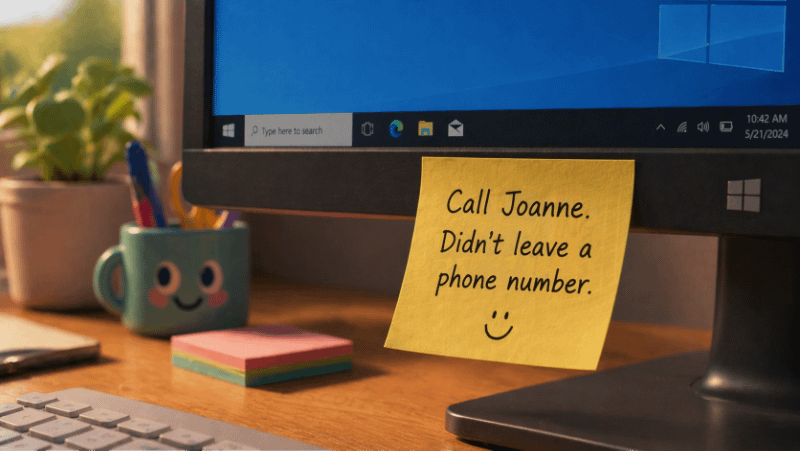 There’s a message sitting somewhere in your office right now.
It came in yesterday afternoon — or maybe last week, who can tell — scrawled on a sticky note by someone who was “just covering the phones for a sec.” The QC manager rang. Something about the batch order. Urgent-ish. The sticky note made it as far as the edge of the monitor before migrating under the biscuit tin (Americans: that’s a cookie tin, and yes, it also doubles as a sewing kit), where it is currently decomposing alongside a pen lid and a 2019 Christmas party invitation.
 “Re-enactment. The sticky note could not be reached for comment.”
Nobody followed up. The QC manager assumed you knew. You assumed someone passed it on. The client assumed you were handling it.
You weren’t.
That little rectangle of adhesive paper just cost you a client relationship, a reorder, and — if you want to do the math properly — somewhere between several hundred and several thousand dollars in lost business. And you’ll never be able to prove it. That’s the really infuriating part.
The Humble Phone Message: Most Underestimated Business Process Since the Filing Cabinet
Here’s what’s strange: companies will spend six months evaluating CRM software. They’ll bring in consultants to optimize their email workflows. They’ll buy a subscription to a “collaboration suite” that costs more per month than a mid-range car payment. And then — *then* — they’ll handle incoming phone messages with a pad from the newsagent and the honor system.
The honor system. In a professional office. In 2026.
The phone message is the last unmanaged process in the modern workplace. Every other piece of information has been digitized, tracked, audited, and CC’d to seventeen people. But “someone called, ring them back” is still being handled the same way it was in 1987, only now the sticky notes are sometimes yellow *and* pink.
The Subscription Mob Moves In
Now, you might say: “Surely there’s software for this.”
There is. Oh, there is.
The software industry, in its infinite wisdom and relentless hunger for recurring revenue, has “solved” the phone message problem the same way it’s solved every other problem in the last decade: with a cloud platform, a per-seat pricing model, and a monthly subscription that starts attractively low and quietly becomes load-bearing infrastructure you’re terrified to cancel.
Let’s talk about what the average office is already paying for, monthly, every month, forever:
- Email — subscription
- Phone system — subscription (and if it’s VoIP, you’re paying per seat and per minute)
- Accounting software — subscription
- Document management — subscription
- CRM — subscription (and there’s always an “enterprise tier” your sales rep is very keen on)
- Video conferencing — subscription
- “Productivity suite” — subscription
- HR platform — subscription
- The coffee machine, somehow — subscription
 At some point in the last ten years, the software industry collectively decided that ownership was a quaint concept, like fax machines and company loyalty, and that what businesses really wanted was to rent everything forever and never actually possess anything.
The pitch is always the same: *”It’s only $X per user per month.”*
And it is. Until you multiply $X by your number of users, by twelve months, by five years, and suddenly realize you’ve paid for the software four times over and you still don’t own it. Cancel the subscription and it vanishes.
Every record, every history, every workflow — gone, or locked behind an export fee, or available in a proprietary format that nothing else can read.
This is not an accident. This is the business model.
The $10,000 Sticky Note, Quantified
Let’s be honest about what phone message mismanagement actually costs.
A message that gets lost — the QC manager’s call, the supplier’s quote, the client checking on delivery — doesn’t just cost the value of that one transaction. It costs the relationship. It signals to the caller that they’re not important enough to be remembered. In a world where clients have seventeen alternatives and can switch suppliers while waiting for their coffee to cool, “we lost your message” is an expensive thing to say.
Add up the staff time spent chasing down whether messages were passed on. The meetings that happen because someone didn’t get a callback. The deals that quietly go elsewhere because a competitor picked up and followed through. The internal friction when two people both think the other one handled it.
Now add the *invisible* costs — the ones that never show up in a report because you don’t know what you didn’t win. The tender you didn’t quote on because the message about the deadline sat on a desk over a long weekend. The referral that went cold because the follow-up call came three days too late.
Sticky notes are not free. They just make it very difficult to see the invoice.
There Is a Saner Way. It Doesn’t Require a Subscription.
PhonePad was built on a premise that feels almost radical in 2026: you should be able to buy software, own it, and use it.
No monthly fees. No per-seat charges that scale uncomfortably as you hire. No “sorry, that feature is only available on the Business Plus tier.” No subscription that silently renews until someone notices the credit card statement. No vendor lock-in that makes cancellation feel like leaving a cult.
You buy it. You own it. It works.
And what it does — quietly, reliably, without drama — is manage your phone messages properly. Every message is logged, time-stamped, and assigned. Whoever takes the call enters the details. The right person gets notified. Follow-ups are tracked. Nothing falls through the cracks. Nothing ends up under the biscuit tin.
It runs on your network, your machines, your terms. The data is yours. It doesn’t need an internet connection to function, which means it keeps working when your ISP is having one of its creative days.
It’s not glamorous. It’s not going to win a design award or get written up in a tech blog as a “paradigm shift in workplace communication intelligence.” It’s going to make sure that when the QC manager calls, whoever answers the phone can take a proper message, route it to the right person, and confirm it was received.
That’s it. That’s the whole thing.
And for a lot of businesses, that’s worth more than a year’s worth of collaboration platform subscriptions.
 The 30-Day Free Trial: Because We’re Not Afraid of You Actually Trying It

We offer a 30-day free trial because we’re confident in what PhonePad does and unafraid of you finding out for yourself.
There’s no credit card required. No “free tier that removes all the useful features.” No trial that quietly converts to a paid subscription unless you find the cancellation button in time. Thirty days, full product, no strings.
If you decide it’s not for you, that’s fine. But if your office has a biscuit tin with a sticky note problem, you might be surprised what a proper solution looks like.
PhonePad is developed by Cybercom Software, built to be owned, not rented.